Human Realistic Torso Phantom
Worldwide Reference Standard For In-Vivo Counting
The HUMAN REALISTIC TORSO PHANTOM was developed under the direction of the U.S Department of Energy, primarily as a reference standard for the in vivo counting of emissions from low-energy transuranic nuclides. The organs of interest are the lungs, liver and lymph nodes. Each of these may be radioactive or inert. These organs are accommodated in a male thorax generally similar to average adult males. This phantom contains a synthetic bone skeleton molded within a soft-tissue-equivalent material.
Organs: All organs are made of soft-tissue equivalent materials. Lungs are available with nuclides uniformly dispersed throughout the lung molding material. Optional organs (developed by Genesiss and not part of the original DOE specifications) are inert but have holes in 2cm2 grids. These either can be filled with inert plugs or with active capsules to establish any desired distribution within the lungs.
The liver has the same loading flexibility with an additional option designed for use with solutions having relatively short half-lives. This liver is a hollow shell with a fill/drain port. If the liver is not required, it may be replaced with the Abdominal Contents, which are also available with a hole matrix, or active.
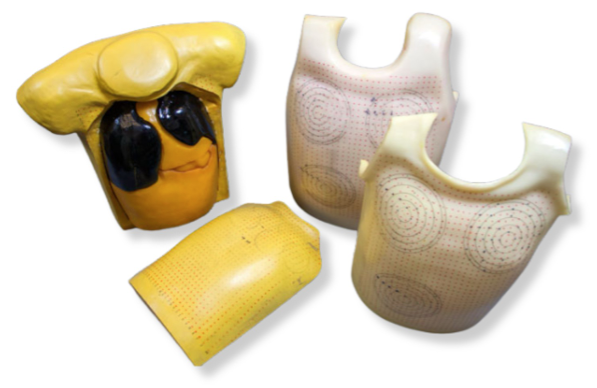
Chest Overlay Plates: Transuranic emissions from individuals with varying amounts of muscle and/or adipose tissue may be so attenuated as to be undetectable. Chest overlay plates were developed to ensure the validity of in vivo counting of such individuals. There are three sets of plates, each in four graded thicknesses. One set is equivalent to 87% adipose and 13% muscle, another is equivalent to 50% adipose and 50% muscle, and the third is equivalent to 100% muscle. Plates of each material and/or each thickness are available separately.
Applications
- Calibration standard for the quantitation of in vivo radioactivity
- Detector calibration for photons deposited in human organs
- In vivo counting of emissions from various isotopes
- Organ bioassays for various isotopes
Targets: Three sets of concentric circles are drawn in permanent black ink over the torso cover and over each chest overlay plate. They range in 1 in. increments from 1 in. to 5 in. in diameter, with a 5.5 in. diameter outer circle. One set of circles is placed over each lung region, with the outer circle tangent to the inferior aspect of the clavicle and protruding over the sternum. The third set is placed over the liver. A 2cm2 grid is projected in red ink over most of the chest surface by the same technique that is used for the circles. All targets are consistent among all phantoms.
Isotopes: Genesiss routinely manufactures active organs with isotopes to suit users' needs. Active capsules to fit into the gridded holes are available, or empty capsules can be supplied to be filled by the user. Genesiss usually supplies the required isotopes, but users may furnish them if so desired. Some isotopes are manufactured only at intervals throughout the year, so delivery is subject to availability. In some cases, calibration costs from governmental sources are subject to wide fluctuations. Isotopes are most often received as calibrated solutions, traceable to the NIST. Organ loading is controlled by micropipetting aliquots from the calibrated solutions. Uraniums and plutoniums are traceable to the NIST by mass. Other isotopes are usually traceable by activity.
Model Numbers
| Model No. | Product Description |
|---|---|
| RS-500 | HUMAN REALISTIC TORSO PHANTOM |
Specifications
| Packing Size | Packing Weight |
|---|---|
| 51W x 51D x 51H cm | 34 kg |
| 20W x 20D x 20H in | 75 lb. |
Genesiss Materials
Soft Tissues: There are unlimited, small variations in density and absorption throughout the human body. Phantom soft tissue is closely controlled to have the average density of these tissues.
Skeletons: Genesiss skeletons are highly detailed polymer moldings which reproduce the shape, mass density and attenuation coefficients of cortical bone and spongiosa. Genesiss's proprietary moldings allow for continuous production, eliminate the restrictions of human skeleton bones (including limited availability, unethical collection of human bone specimen, variable size, and uncertain chemical composition), and avoid the loss of marrows in dried natural skeletons thereby making Genesiss skeletons superior to "real bone."
Molds: Molds for the Genesiss cortical bone and spongiosa were made from human skeletons consistent with the sizes of the soft tissue molds.
ICRU 44: Genesiss skeletons conform closely to the standards established by the International Commission on Radiation Units and Measurements (ICRU Report No. 44); mass density is reduced slightly to take into account a small decrease in calcium content for older patients.
Linear Attenuation Data
- Monte Carlo simulation was used to calculate linear attenuation coefficients as a function of beam.
- Monte Carlo results were validated with linear attenuation coefficients derived from Hounsfield Unit measurements at discreet energy levels.
- Genesiss Phantom material linear attenuation data was compared to NIST data using ICRU Report 44 compositions of human tissues.
- NIST data was interpolated when necessary.
| MATERIALS | DENSITY (g/cc) |
|---|---|
| Genesiss Soft Tissue (Opaque) | 1.08 |
| Genesiss Soft Tissue (Transparent) | 1.10 |
| Genesiss Cortical Bone | 1.83 |
| Genesiss Trabecular Bone | 1.17 |
| Energy (MeV) | Mean (HU) | Calculated (μ) | μ (ICRU 44) | % Diff | Ratio |
|---|---|---|---|---|---|
| 00.08 | 60.30 | 0.1948 | 0.1932 | 0.80% | 0.9921 |
| 00.10 | 52.88 | 0.1797 | 0.1795 | 0.15% | 0.9985 |
| 00.12 | 57.10 | 0.1717 | 0.1709 | 0.44% | 0.9956 |
| 00.14 | 52.95 | 0.1623 | 0.1624 | 0.07% | 1.0007 |
| 00.20 | -- | 0.1477 | 0.1439 | 2.61% | 0.9746 |
| 00.30 | -- | 0.1245 | 0.1246 | 0.04% | 1.0004 |
| 00.60 | -- | 0.0950 | 0.0941 | 1.01% | 0.9900 |
| 00.80 | -- | 0.0825 | 0.0826 | 0.13% | 1.0013 |
| 01.00 | -- | 0.0744 | 0.0743 | 0.18% | 0.9982 |
| 02.00 | -- | 0.0520 | 0.0519 | 0.18% | 0.9982 |
| 03.00 | -- | 0.0351 | 0.0357 | 1.71% | 1.0174 |
| 06.00 | -- | 0.0288 | 0.0291 | 0.88% | 1.0088 |
| 08.00 | -- | 0.0252 | 0.0255 | 0.98% | 1.0099 |
| 10.00 | -- | 0.0229 | 0.0232 | 1.49% | 1.0151 |
| 15.00 | -- | 0.0203 | 0.0203 | 0.15% | 0.9985 |
| 20.00 | -- | 0.0189 | 0.0189 | 0.17% | 1.0017 |
| Energy (MeV) | Mean (HU) | Calculated (μ) | μ (ICRU 44) | % Diff | Ratio |
|---|---|---|---|---|---|
| 00.08 | 1365 | 0.4345 | 0.4280 | 1.51% | 0.9851 |
| 00.10 | 1048 | 0.3496 | 0.3562 | 1.84% | 1.0188 |
| 00.12 | 0977 | 0.3211 | 0.3274 | 1.91% | 1.0195 |
| 00.14 | 0902 | 0.2932 | 0.2986 | 1.80% | 1.0184 |
| 00.20 | -- | 0.2511 | 0.2513 | 0.09% | 1.0009 |
| 00.30 | -- | 0.2155 | 0.2137 | 0.84% | 0.9916 |
| 00.60 | -- | 0.1596 | 0.1598 | 0.11% | 1.0011 |
| 00.80 | -- | 0.1403 | 0.1402 | 0.10% | 0.9990 |
| 01.00 | -- | 0.1274 | 0.1261 | 1.06% | 0.9895 |
| 02.00 | -- | 0.0883 | 0.0885 | 0.17% | 1.0017 |
| 03.00 | -- | 0.0611 | 0.0625 | 2.29% | 1.0235 |
| 06.00 | -- | 0.0512 | 0.0525 | 2.46% | 1.0253 |
| 08.00 | -- | 0.0468 | 0.0474 | 1.20% | 1.0121 |
| 10.00 | -- | 0.0446 | 0.0444 | 0.39% | 0.9962 |
| 15.00 | -- | 0.0410 | 0.0409 | 0.16% | 0.9984 |
| 20.00 | -- | 0.0393 | 0.0397 | 1.02% | 1.0103 |
| Energy (MeV) | Mean (HU) | Calculated (μ) | μ (ICRU 44) | % Diff | Ratio |
|---|---|---|---|---|---|
| 00.08 | 551 | 0.2849 | -- | -- | -- |
| 00.10 | 515 | 0.2586 | -- | -- | -- |
| 00.12 | 439 | 0.2337 | -- | -- | -- |
| 00.14 | 318 | 0.1541 | -- | -- | -- |